
Call of Duty Mobile’s Impossible Journey Into China’s Walled Garden
It was a sweltering August morning in 2020 when the news broke across Chinese gaming forums like a flashbang in a dark room. After ten agonizing months of radio silence, the official word landed: Call of Duty Mobile had been granted a license. For a title drenched in military hardware and visceral firefights, this wasn’t just a regulatory green light — it was a diplomatic miracle. The pre-registration button went live, and within hours, millions of thumbs had already hit it, flooding Tencent’s servers with a hunger that had been building for years.
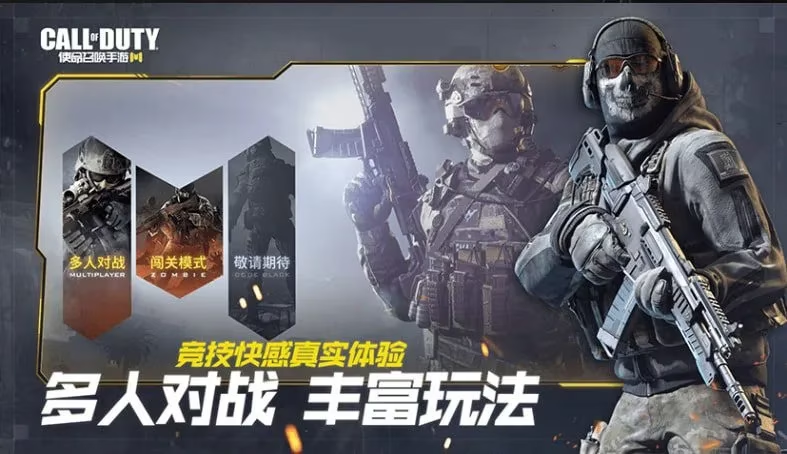
For anyone who has tracked the labyrinthine game approval process in China, the sight of that pre-registration page felt surreal. Since 2018, the State Administration of Press and Publication had tightened its grip on digital entertainment with the subtlety of a vice. No longer was it merely about technical compliance; every pixel, every line of dialogue, every scrap of narrative had to pass through an ideological sieve. Western publishers routinely threw up their hands, labeling the market unreachable. Google Play was absent, replaced by a jungle of third-party Android stores, each with its own opaque submission rules. Entering China without a native titan like Tencent was akin to storming a fortress with a water pistol.
Yet Tencent didn’t just knock on the door — they rebuilt the hinges. The Shenzhen-based behemoth secured exclusive publishing rights for Call of Duty Mobile, a feat that required delicate choreography. The approval arrived in a wave that also swept in heavy hitters like Harry Potter: Magic Awakening and Total War: Arena, but none carried the symbolic weight of CoD. Here was a franchise synonymous with kinetic violence, headshots, and cinematic bloodshed, now being sanitized for a regulatory body that had previously forced PUBG Mobile to rewrite its very identity as Game For Peace. Everyone braced for a similar overhaul.
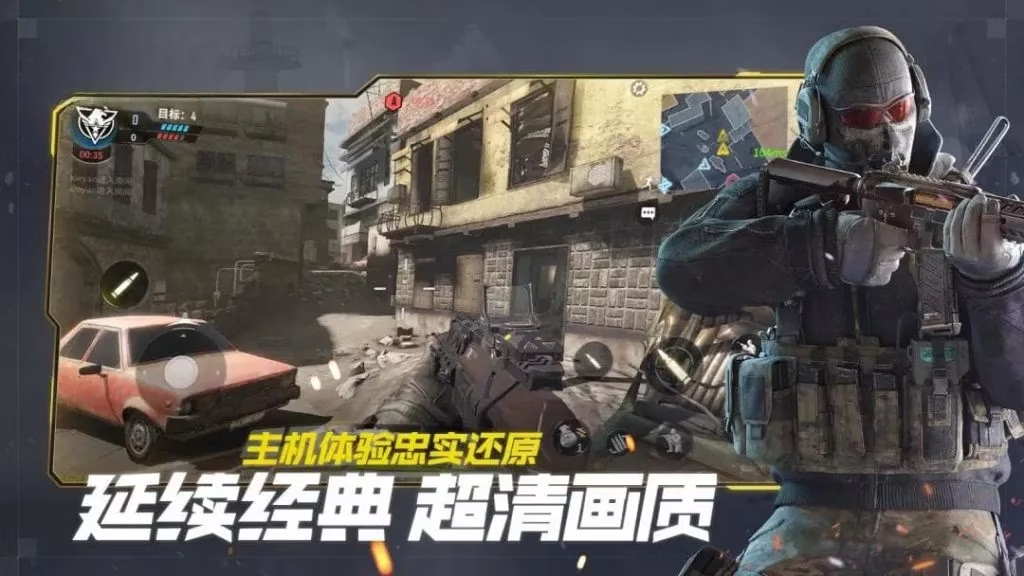
Activision and TiMi Studios — Tencent’s internal powerhouse — understood the tightrope they had to walk. Leaks and early test builds suggested that gore effects were softened, kill animations dialed back, and death comms filtered into something almost patriotic. Enemies no longer splattered; they faded. The iconic skull emblem? Quietly redesigned into a stylized wing. Yet the core loop — the crackling weapon mechanics, the map flow, the killstreak adrenaline — remained eerily intact. It was the same game, just wearing a diplomatic tie. Chinese gamers, long accustomed to such adaptations, barely flinched. They cared about one thing: could they finally squad up on Crossfire and Standoff without a VPN?
When pre-registration opened, the numbers told a story no PowerPoint could capture. In under 24 hours, the tally rocketed past 10 million, a figure that made even seasoned Tencent executives raise their eyebrows. The anticipation had been quietly nurtured through esports whispers, creator content, and the global version’s dominance on Twitch and YouTube. For a country where the mobile gaming market was already a $30 billion colossus, this was the missing titan that could bridge the gap between casual kings like Honor of Kings and the hardcore shooter audience.
What made the approval even more staggering was the geopolitical timing. 2020 was a year of fraying wires between China and the West, with tech decoupling dominating headlines. In that climate, a quintessentially American military shooter getting stamped by Beijing felt almost paradoxical. Analysts pointed to Tencent’s leverage: the company wasn’t just a publisher; it was a shareholder in Activision Blizzard and a partner on the global CoD Mobile project itself. The government, in turn, saw a chance to keep gaming revenues inside its own ecosystem rather than losing them to gray-market APK downloads. Pragmatism, as always, won the day.
Looking back from 2026, that August launch window now appears as a watershed moment. Call of Duty Mobile didn’t just survive China’s approval gauntlet — it thrived, evolving into a esports staple with its own local circuit, quietly adjusting seasonal content to avoid cultural tripwires. The pre-registration frenzy proved that even the most improbable IPs could find a home behind the Great Firewall, provided the right guardians held the keys. For Actvision and TiMi, the lesson was clear: patience, partnership, and a willingness to repaint the bloodstains could conquer any wall. The game that once seemed forever barred had finally arrived — and it never left.
Comments