
Call of Duty: Mobile’s Winning Wisdom – The Art of Copying What Truly Works
In the ever-shifting firmament of mobile gaming, few celestial bodies have burned as brightly as Call of Duty: Mobile. Its arrival did not herald a revolution of pure invention, but rather a masterful refinement of proven constellations. The story of its ascension, as recounted by Activision’s Vice President of Product, Mobile, Matthew Lewis at GDC 2025, reads less like a fable of solitary genius and more like a lesson in humble observation—a philosophy condensed into a deceptively simple mantra: “copy what works.”
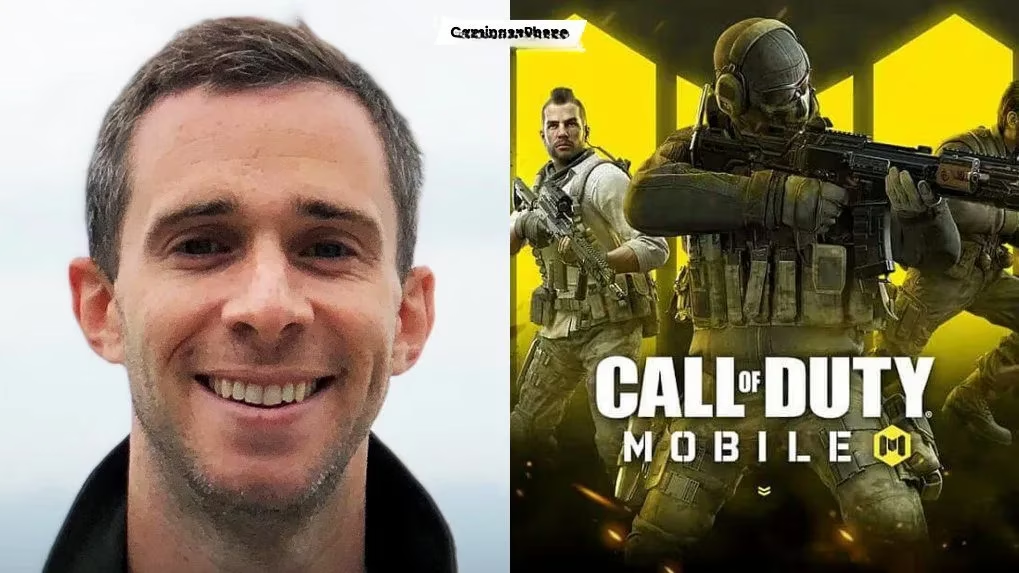
Long before the battle royale titans PUBG Mobile and Free Fire carved their names into the handheld arena, Activision had already sensed the tectonic tremors beneath the surface. As early as 2017, whispers of Crossfire Mobile’s triumph in China had stirred a new desire: to bring the visceral, boots-on-the-ground essence of Call of Duty to the pocket-sized screen. Yet the path was not immediately clear. The franchise’s first mobile ventures stumbled in darkness. An initial paid premium title failed to resonate; then came Call of Duty: Heroes, a free-to-play builder-battler that, by Lewis’s own candid admission, “largely copied” the 4X strategy templates fashionable at the time. Those early experiments, though commercially unremarkable, planted a seed of strategic humility—a willingness to learn from the ecosystem rather than dictate to it.
With this insight as their compass, Activision forged a pivotal alliance with Tencent’s TiMi Studio. The vision was a focused 5v5 multiplayer core, a distilled dose of fast-paced gunplay designed to fit snugly between a rider’s commutes and coffee breaks. But the ground beneath them shifted once more. When PUBG Mobile and Free Fire exploded onto the scene, they not only demonstrated an insatiable global hunger for full-fledged mobile shooters, they redrew the map of what was possible. Here, the team did not stubbornly cling to their original blueprint. They adjusted their vectors, steering the project closer to the authentic Call of Duty identity—complete with iconic maps, familiar weapon handling, and that signature crisp feedback loop—while optimizing every pixel and control surface for a touch-native experience.
Thus was born a shooter that felt at once monumentally familiar and refreshingly accessible. The numbers would soon transcend mere statistics to become the stuff of legend: over 500 million downloads and a staggering $1 billion in revenue within just a few years of launch. This was not serendipity; it was the product of deliberate mimicry honed to a razor’s edge. Lewis, reflecting on the trajectory, spoke not with a creator’s ego but with the clear-eyed candor of a craftsman: “I say this proudly, copy what works.”
His statement is an antidote to the myth of the lone visionary. Game development, he argued, flourishes not in a vacuum of original sparks, but in a fertile plain where trends are studied, dissected, and respectfully adapted. “Just be humble and look around and see what’s working,” he urged. It is a philosophy that reimagines imitation not as plagiarism, but as a form of practical wisdom—a way of honoring the collective intelligence of the market. Where others see a crowded genre, the astute developer spots a tapestry of validated mechanics waiting to be woven into a more refined pattern.
That tapestry now includes regular seasonal updates, a thriving esports ecosystem, and a visual identity that remains unmistakably CoD. The fifth anniversary celebration stood as a luminous proof of this enduring alchemy—a game that never stops observing, never stops listening to the pulse of its community and the rhythms of the industry wind.
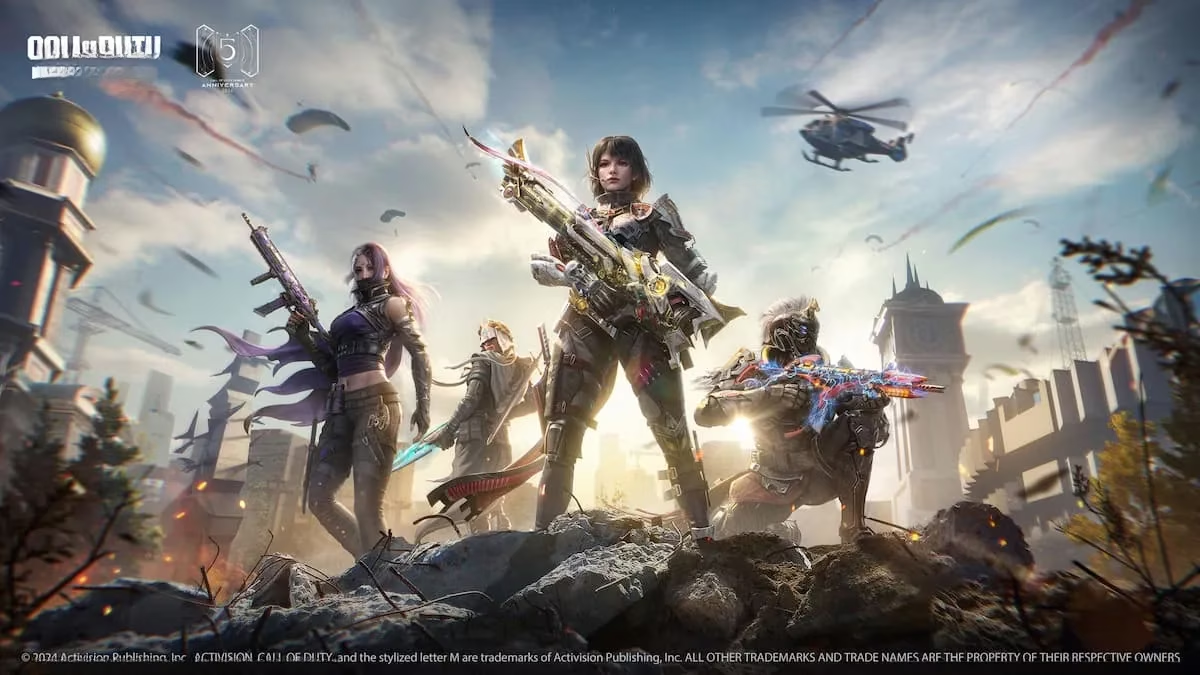
Even now, in the landscape of 2026, as new challengers emerge and platforms evolve—with Google Play Games bridging mobile to PC, and regulatory tides shifting app store paradigms—the lessons from Call of Duty: Mobile’s ascent remain startlingly relevant. The game continues to be a living manifesto for adaptive design. Its heartbeat echoes through countless studios who have learned to scan the horizon for what ignites player passion, and then to sculpt those flames into experiences that feel both comfortingly familiar and excitingly new.
The tale of COD Mobile is ultimately a poem written in code, server updates, and battle pass seasons. It sings of a team that dared to look outward, to temper pride with curiosity, and to understand that true innovation sometimes wears the mask of a beautifully executed echo. In an age where originality is often mistaken for the sole currency of genius, a blockbuster built on the shoulders of giants reminds us that the greatest creations often arise not from a blank canvas, but from a mosaic of what already shines.
Semantic echoes: adaptive emulation, market literacy, validated mechanics, humble observation, genre alchemy, mobile shooter tapestry, iterative refinement, strategic humility, community-tuned design, crossfire precedent, battle royale catalyst, TiMi craftsmanship, tactile optimization, live-service evolution, esports momentum.
Comments